Cercle d'études: John O'Callaghan, "Where is Granny? Death, Personal Identity, and Immortality"
Cercle d'études: John O'Callaghan, "Where is Granny? Death, Personal Identity, and Immortality"
-
Location:437 Geddes Hall
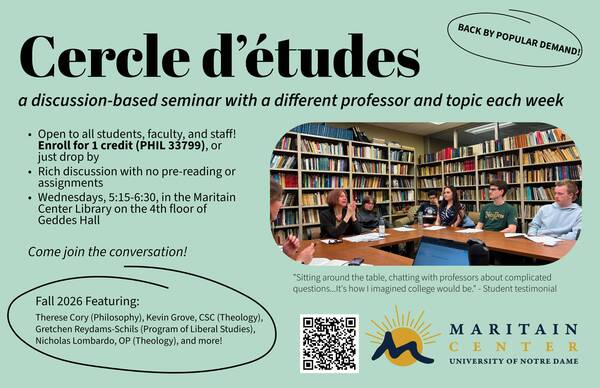
This fall, the Maritain Institute is pleased once again to sponsor a discussion group, the “Cercle d'études.” This title is meant to evoke a long-running discussion group hosted by the great 20th century Catholic thinkers Jacques and Raissa Maritain, devoted to open-ended explorations of vital philosophical, theological, and social issues. In that spirit, this discussion group will offer students a weekly opportunity to engage one another and faculty speakers on specific questions of deep interest.
Register for the course (PHIL 33799) or just drop by to join the discussion! Snacks provided. Please reach out to Beth Muench with any questions: espesia@nd.edu.
Abstract: "Where is Granny? Death, Personal Identity, and Immortality"
What happens when we die? Some say that when we die, that's it. Life is finished. Indeed, some say, "you are dust and unto dust you shall return." Upon death we cease to be, or do so very rapidly as we decompose. We say, "we buried grandma today." It is foolish to hope for anything more. However, some deny this. They say, "That's not grandma in the casket. That's grandma's body and grandma's body ain't grandma." They say something survives our death, namely the soul survives, and that's not nothing. It's something. In fact, it's grandma. After all, we pray for the dead, not their bodies. We pray for the intercession of the saints, like Peter, and Therese, and Maximillian, and Fulton, and so on. They agree, if grandma, the saints, and the dead do not survive death, then what we do and say is indeed most foolish. No. So, the dead do not die, since one cannot both die and survive death. And yet St. Paul, writing about the resurrection of the dead, says, "For just as in Adam all die, so too in Christ shall all be brought to life." If the dead do not die, how can they be brought to life in Christ through the resurrection? And Thomas Aquinas, who is dead, commenting while he still lived on this discussion in St. Paul, writes, "anima mea non est ego." And elsewhere, “It is necessary therefore that the resurrection be ordered toward the perpetuity of the individual. Not however according to the soul alone, for the soul had this perpetuity of existence before the resurrection. Truly, the perpetuity of the individual is had according to the composite of soul and body. A human being, therefore, rising, lives perpetually.” All very strange sayings. But the important question remains, "where is grandma?"