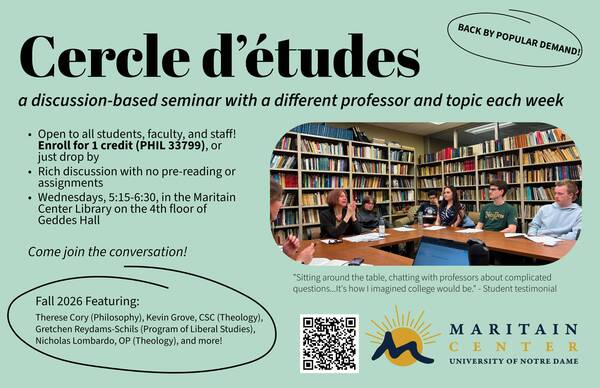
This fall, the Maritain Institute is pleased once again to sponsor a discussion group, the “Cercle d'études.” This title is meant to evoke a long-running discussion group hosted by the great 20th century Catholic thinkers Jacques and Raissa Maritain, devoted to open-ended explorations of vital philosophical, theological, and social issues. In that spirit, this discussion group will offer students a weekly opportunity to engage one another and faculty speakers on specific questions of deep interest.
Register for the course (PHIL 33799) or just drop by to join the discussion! Snacks provided. Please reach out to Beth Muench with any questions: espesia@nd.edu.
Persons, Individuals, and Jacques Maritain’s Challenge to Modern Political Philosophy
Jacob Saliba
Abstract: The French Catholic philosopher Jacques Maritain once argued that, in the wake of modernity,
our conception of human nature had become split into divergent categories of “individuals” and
“persons,” with the former as a secular construct and the latter as the sole guarantor of true
human dignity according to Church teaching. 1 Maritain’s chief contention was that as
individuals, human beings only appear as isolated entities in society, subordinated to the
temporal laws of the state and no longer exercising transcendent agency and ethical duties. In
contrast, the view of human beings as persons guarantees that everyone, by possessing a soul and
God-given dignity, transcends the failures of the temporal order and the ills of a given political
regime. A crucial implication of this distinction concerned the threat of totalitarianism and the
evil of the Holocaust which reduced human beings to lifeless cogs in a machine, cast aside with
no dignity, freedom, or sacred value. Totalitarianism, according to Maritain, only reinforced the
egocentric dangers of individualism that seeks to isolate human beings rather than put them into
communion with one another. This distinction between persons and individuals is one of the
most important interventions of Catholic philosophy, legal theory, and politics in the last century
as well as of the most crucial ingredients to Maritain’s own systematic political thought on
questions of the common good, rights, responsibilities, and democracy.