Cercle d'études: Spring 2026
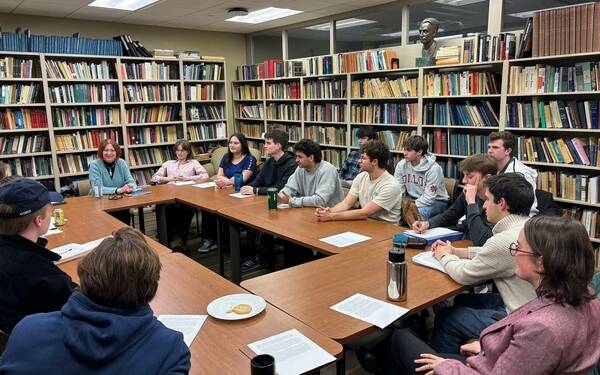
Welcome to Cercle d'études, Spring 2026! Here you will find some resources for the spring 2026 iteration of the Cercle, as well as an overview of the semester's speakers and topics.
Resources
A few key resources for current students:
Contact information:
Instructor: Prof. Jean Porter
Need logistical support? Contact Maritain Center Program Manager, Christopher Enabnit
Want to share an announcement with the Cercle? Contact Maritain Center Communications Coordinator, Grayden McCashen
Syllabus:
Download Cercle d'études Spring 2026 Syllabus [PDF, 65k]
Speakers and Topics
January 14th: Introduction
Speaker: Prof. Jean Porter (Theology)
January 21st: Am I Unjustly Withholding My Excess Possessions from the Needy? Aquinas's Ethical Challenge to Us.
Speaker: Prof. Therese Cory (Philosophy)
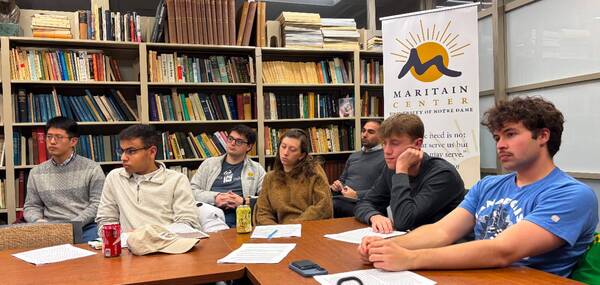
Overview: In his first apostolic exhortation, Dilexi Te, discussing our obligations to the poor, Pope Leo quotes St. Gregory the Great: "Do not waste the opportunity of doing works of mercy; do not store unused the good things you possess.” For St. Gregory, this is more than sound moral advice; it is a requirement of justice; elsewhere he says: "When we attend to the needs of those in want, we give them what is theirs, not ours. More than performing works of mercy, we are paying a debt of justice.” In his Summa theologiae, Aquinas agrees, saying that "whatever is had in superabundance is due, by natural law, to the purpose of aiding the poor," and asserting that it is not stealing to take what someone urgently needs from someone else's excess goods. This is not an isolated view but also appears in St. Basil the Great, St. John Chrysostom, and St. Ambrose -- and recently triggered some discussion online (here). We will unpack the underlying philosophical and theological concepts and discuss: Is he right? If so what are the concrete implications for our moral life?
January 28: Are We in a Crisis of Democracy?
Speaker: Prof. Patrick Deneen (Political Science)
Overview: Popular commentators are fond of claiming that we are in a crisis of democracy - but is this true? This week Prof. Patrick Deneen defined liberalism, democracy, and led a discussion on the state of each.
February 4: Natural and International Law
Speaker: Prof. Mary Ellen O’Connell (Law School)
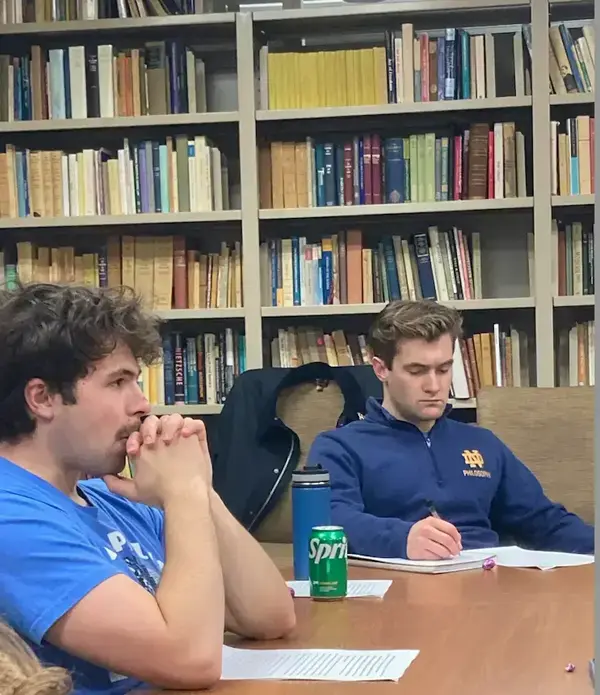
Overview: Prof. O'Connell lead a robust discussion of the relationship between Natural Law, especially as understood by Jacques Maritain, Hersch Lauterpacht, and our own Prof. Jean Porter, and its connection to International Law Theory. This discussion allowed students to analyze the United Nations Declaration of Human Rights through a natural law framework and debate its potential implications.
February 11: Special Event: "When Does Life Begin? Thomist versus Dualist Perspectives"
Speaker: Prof. Jason Eberl (St. Louis University)
Overview: This special event version of the Cercle d'études has students travel from our cozy library on Geddes 4 to DeBartolo 126 to hear a lecture from visiting speaker Prof. Jason Eberl. Part of the Maritain Fellows Lecture series, the lecture addresses the question, "When does a human being become ensouled?" Thomists and dualists have offered differing accounts in response to this question. Prof. Eberl's lecture will critique the views of dualists such as Richard Swinburne and William Hasker and will instead argue for a Thomistic hylomorphic understanding of ensoulment at conception.
February 18: "What is Economic Growth?: A Brief Economic History of the World"
Speaker: Prof. Mary Hirschfeld (Business/Theology)
Overview: The AI optimists tell us that we are just around the corner from unprecedented prosperity. Self-programming AI robots will expand productivity and human welfare will be dramatically increased. Leaving aside the profound questions about whether a workless world is desirable, I want to ask what exactly we think this unprecedented prosperity consists of. To do that I want to give some historical backdrop on what economic growth has meant for lived human experience in the past, as a way of setting up a conversation about what more we might hope for or expect from ongoing economic growth.
February 25: "Toward Rhetorical Virtue: Ethics and the Teaching of Argument"
Speaker: Prof. John Duffy (English)
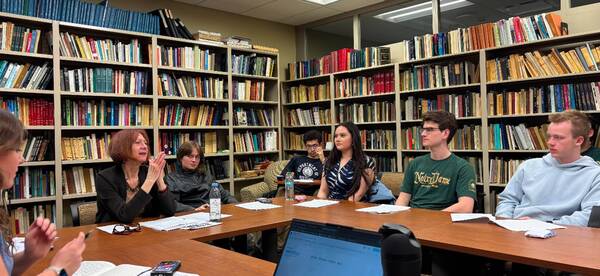
We commonly think of argument in terms of proofs, polemics, and persuasion. In this talk, John Duffy proposes argument should be understood as an inherently ethical activity that arises from the relationships of the interlocutors, and that the teaching of argument is necessarily and inescapably the teaching of ethical discourse practices, or what Duffy calls “rhetorical virtues,” such as truthfulness, open-mindedness, and intellectual courage. Duffy suggests that instructors across all disciplines should foreground the ethical dimensions argument to better equip students to make and evaluate arguments in an increasingly polarized civic culture.
March 4: "The Church as Leaven in Society: The Fate of a Maritainian Theme"
Speaker: Prof. Gerald McKenny (Theology)
Jacques Maritain argued that rather than influencing society through the coercion of the state, the Church should act as a leaven that raises society to a higher level within its own order. The Catholic philosopher Charles Taylor argued that the end of Christendom has enabled the Church to influence society in this way, while (then-) Cardinal Ratzinger argued that the loss of Christendom poses challenges that complicate the Maritainian strategy. Today, many Catholics have lost confidence in the Maritainian strategy. Is their loss of confidence justified, or is that strategy still viable?
March 18: "Is humility essential for fruitful liberal learning? If so, how can we acquire it?"
Speaker: Prof. Mary Keys (Political Science)
This discussion will begin from arguments by Augustine of Hippo and Thomas More about the virtues needed for fruitful liberal learning, focusing on humility and modesty/moderation. Is Thomas More on to something significant, in our time as well as his, when he writes to his children's tutor, William Gonell, asking him to incorporate readings from Church Fathers such as Augustine and Jerome in their classical curriculum? Is More correct that vainglory and pride are obstacles to a fruitful liberal education as well as to honest citizenship and responsible leadership? Do humility and lofty character, modesty and magnanimity, oppose one another or mutually reinforce and motivate? I'll argue for continued salience of humility and moderation, with resources from Augustine and More, to open the conversation.
March 25: "Are you called to what you are studying?"
Speaker: Prof. David Richter (Civil & Environmental Engineering and Earth Sciences)
I am a professor in the Civil and Environmental Engineering and Earth Sciences Department, and over the years I have grown more and more emphatic that students, particularly engineers, would benefit from at least asking the question “Am I called to this course of study?”. To this end, I developed a Catholicism and the Disciplines course (counting as a 2nd philosophy credit for Notre Dame undergraduates) centered on this question. My remarks at this Cercle d'études gathering will be broadly based on this idea, which necessarily involves addressing additional questions, including: If it is a calling, then who is calling, and how do I respond? If not, then what is my criteria for discernment? Is the point of a university to prepare me for a job? If not, then what is the point of a university? How do financial tradeoffs, like tuition and earning potential, factor in? In my limited experience engaging with students on these and related questions, I have found that there are many who could benefit from at least considering them in the context of what they currently consider their life plan.
April 1: "Aquinas Goes to Washington: The Order of Love, Immigration, and Civic Obligation"
Speaker: Prof. Jean Porter (Theology)