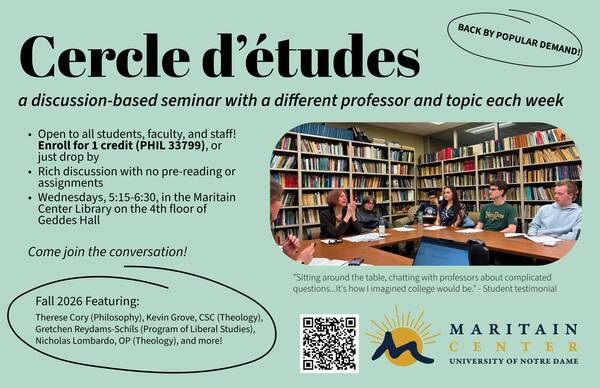
This fall, the Maritain Institute is pleased once again to sponsor a discussion group, the “Cercle d'études.” This title is meant to evoke a long-running discussion group hosted by the great 20th century Catholic thinkers Jacques and Raissa Maritain, devoted to open-ended explorations of vital philosophical, theological, and social issues. In that spirit, this discussion group will offer students a weekly opportunity to engage one another and faculty speakers on specific questions of deep interest.
Register for the course (PHIL 33799) or just drop by to join the discussion! Snacks provided. Please reach out to Beth Muench with any questions: espesia@nd.edu.
September 9: Fr. Nicholas Lombardo
“Why logic is a lot more interesting than you might think: Two examples”
Abstract: It is safe to say that books on logic do not frequently make the New York Times bestseller list. Even among professional philosophers, a great many prefer to focus on topics besides logic in their teaching and research. And yet, while logic does not have a reputation for intellectual excitement, partly due to the way logicians go about their business, in fact, logic can be extremely interesting. One key insight is realizing that logic is not just about how to reason correctly, or whether X implies Y, or how to spot bad reasoning; it’s also about how words work, and how our words connect to reality.
The boardgame Othello has the tagline: “A minute to learn. A lifetime to master.” In this Cercle d’etudes, we will discuss two logical puzzles that take a minute to grasp, and yet have occupied some of history’s greatest minds for much of their lives. One is about language and Gottlob Frege’s sense/reference distinction, and the other is about the Christian doctrine of the Trinity, and how it can make logical sense to say that God is both one and three.