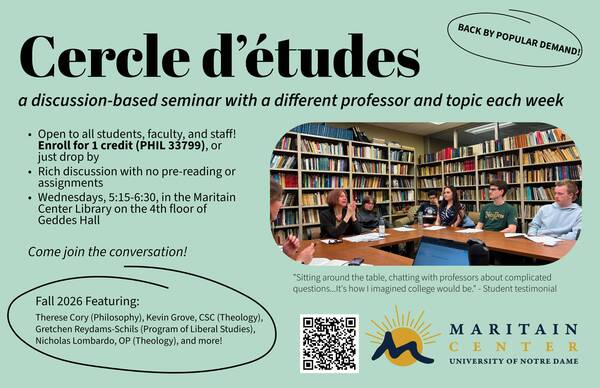
This fall, the Maritain Center is pleased once again to sponsor a discussion group, the “Cercle d'études.” This title is meant to evoke a long-running discussion group hosted by the great 20th century Catholic thinkers Jacques and Raissa Maritain, devoted to open-ended explorations of vital philosophical, theological, and social issues. In that spirit, this discussion group will offer students a weekly opportunity to engage one another and faculty speakers on specific questions of deep interest.
No pre-reading or registration is required -- just drop by and join the conversation. Snacks provided. Please reach out to Beth Muench with any questions: espesia@nd.edu.
Speaker: Prof. David Cory
Don't Look Now!
Theater as Breeding Grounds for (Toxic?) Empathy in Augustine's Confessions
Abstract: Like many in the ancient world, St. Augustine took the passions to be among the most serious obstacles to the moral life. In his Confessions, he identifies the theater and literature and the feelings they arouse as breeding grounds of corrupting feeling. Not only does he cry (already regarded with suspicion by Stoics and others) but he cries for the guilty passion of Aeneas and Dido, fictionalized characters he does not even know. Augustine's criticism of weeping at fictional distress bears at least a passing resemblance to a growing suspicion in contemporary culture of all that arouses empathy. "Toxic empathy" has become a term used to criticize those who, perhaps self-indulgently, feel the anguish of others and consequently fail in duties that are harsh, such as punishing the criminal. How might Augustine weigh in on debates about “toxic empathy”? Separately, is he discouraging the development of sentiment through literature and theater? More generally, what role (if any) does empathy, especially as fostered by fiction have in the cultivation of virtue and moral excellence?