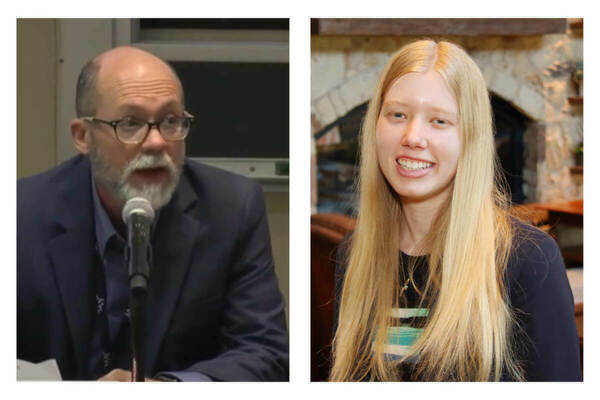
Alexa Hassell, president of the graduate Maritain Fellows, was able to interview Christopher Tollefsen, visiting fellow at the de Nicola Center for Ethics and Culture and professor of philosophy at the University of South Carolina. This spring, Prof. Tollefsen led a reading group with the Maritain Fellows on his current book project Killing and Christian Ethics.
ALEXA HASSELL: You are a visiting fellow with the de Nicola Center for Ethics and Culture at Notre Dame. How have you liked your time at the university? How has your research benefited from being at ND?
CHRISTOPHER TOLLEFSEN: It has been a wonderful year! The intellectual and spiritual environment at Notre Dame has been extremely enriching. I’ve been to talks in a wide variety of disciplines, spent time with friends in the law school, theology, and philosophy, and benefitted from Notre Dame’s library, which is outstanding. The de Nicola Center has been a lovely home away from home. And a special word of thanks is due to my “fellow fellows” in the Center, Chris Kaczor, Fr. Javier Prades Lopez, and Dan Philpott. It has been a pleasure and privilege to spend time with them.
AH: The dCEC maintains the papers of Germain Grisez, an eminent moral philosopher who helped develop an approach to ethics now often called “new natural law theory.” What are the salient features of “new natural law theory?” How can it be contrasted with other predominant approaches to ethical inquiry? In what ways have Grisez’s life and work impacted your own philosophical career?
CT: I guess it is worth saying to begin with that I did not know that the archived papers of Grisez were here at Notre Dame until this interview! I plan to spend some time with them before I leave.
Like John Paul II, in one way, and Elizabeth Anscombe, in another, Germain Grisez helped remind philosophy (and theology) of the importance of considering human goods and human acts from the standpoint of the acting person. Rather than view human nature “sideways on,” as a fact to be contemplated theoretically before drawing moral conclusions, Grisez stressed the importance of the agent’s practical perspective, and of deliberating practically with a view to what is understood by practical reason as giving the person reason to act: basic or fundamental human goods that promise aspects of genuine human fulfillment.
For me, that has always been methodologically fundamental: in ethical reflection, one must consider practical problems in light of the goods such as life, health, knowledge, sociality, marriage, or religion that are at stake. One must also consider what it means to be uprightly related toward those goods, not destroying some for the sake of others, and towards all the human beings for whom they are good, not discounting some because they are very young, or very old, or disabled, for example.
AH: What is your current research project? What motivated you to undertake it?
CT: I’ve worked on two book projects this year. One is a book about the ethics of killing titled Killing and Christian Ethics. The book is a kind of sequel to my earlier Lying and Christian Ethics and addresses a puzzle raised by a reviewer of the earlier book: I argued there that Christian ethics should reappropriate the Augustinian and Thomistic view that lying is always morally impermissible. Yet I have argued over my career that both saints are too permissive in their views about intentional killing when undertaken by those with public authority. Both hold, for example, that an executioner may permissibly intend the death of a convicted criminal.
By contrast, Killing and Christian Ethics argues for a view that is expressed in recent editions of the Catechism of the Catholic Church, as at 2268: “The fifth commandment forbids direct and intentional killing as gravely sinful.” That claim makes no exceptions for those in public authority, and thus rules out, among other things, capital punishment.
The other book is tentatively titled The Neglected Goods: The Ethics and Politics of Play and Aesthetic Experience. I think that both play and the experience of beauty are among the basic human goods that are constitutive aspects of human flourishing, but by and large, natural law theorists have not had a lot to say about these goods: they’ve been neglected! Being at ND has allowed me to make a good start on this project, but there is a lot of work left, and I look forward to thinking and writing more about this topic in the year to come.
AH: Your scholarship often engages ethical questions that are matters of vigorous debate in the public square and among those shaping government policy. How do you see the intersection of ethical questions and public policy? In other words, what ways do philosophical contributions to a topic of contemporary significance exert influence on the shaping of public policy?
CT: Very frequently there is not one right answer to a public policy question: there can be multiple morally upright ways of pursuing some reasonable political purpose, and part of the purpose of ethical reflection is to identify the permissible alternatives. But often there are certainly wrong ways of seeking politically important ends, and a further purpose of ethical reflection is to identify those prospective public policy choices that go definitely morally wrong.
So, for instance, it is important to promote family and procreation: any polity that does not do so is sowing the seeds of its own destruction. And there are surely many ways to permissibly do this. But to promote the population growth by focusing on various forms of artificial reproductive technology, such as in vitro fertilization, is gravely immoral. Such technologies typically result in the creation and destruction or cryopreservation of many surplus (“spare”) human embryos, and always involve treating a human person as a thing to be made at will. And so it is an important task of moral philosophers and theologians to make this case in the public square, in an effort to shape a morally sound public policy.
Of course, success is never guaranteed. But what is the alternative? The stakes in this, and many other cases, are too high to simply throw up one’s hands, and so moral philosophers and theologians need to continue to make their case in the public square as best they can.
AH: What’s in store for the future? What’s your next project?
CT: In 2021, The University of Notre Dame Press published a book I co-wrote with a physician friend and colleague, Farr Curlin, of Duke University, called The Way of Medicine: Ethics and the Healing Profession, in which we argued that contemporary medicine has lost sight of a foundational question its practitioners need to ask: what is medicine, and what is medicine for? We argued for a simple answer: the purpose of medicine is human health, and in particular the health of the physician’s patient. But that simple answer is currently contested by those who see medicine only as a set of technical skills which are to be deployed to satisfy a wide array of patient desires and preferences.
Dr. Curlin and I are planning to teach a graduate seminar at Duke in Spring 2026 that we hope will provide a springboard for a sequel to The Way of Medicine, which we plan to call Suffering and the Limits of Medicine. The view that the relief or end of suffering is among the most fundamental purposes of medicine is not entirely wrong—to heal is to relieve suffering. But it is not entirely right either: many forms of suffering lie outside the physician’s purview, and the idea that ending suffering is the goal that matters most can lead, for example, to ending the life of the sufferer, if that is what is necessary to end a patient’s suffering. We’re both looking forward to working together on this new project.