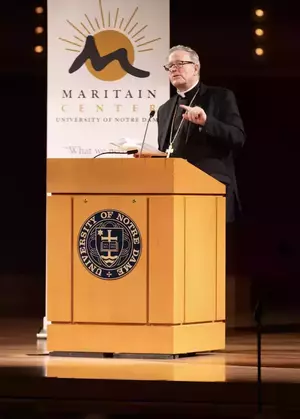
Bishop Barron Delivers Third Annual Maritain Lecture
The Thursday before Spring Break, the Maritain Center hosted its third Annual Maritain Lecture. Following the series' inaugural lecture by Margarita Mooney Clayton and last year's address by Eleonore Stump, this year's speaker was Bishop Robert Barron, of the Diocese of Winona-Rochester (Minnesota). Bishop Barron is the founder of Word on Fire Catholic Ministries and an important voice in the life of the Church, as well as an accomplished scholar and teacher of Scripture, Church History, Theology, and Philosophy.
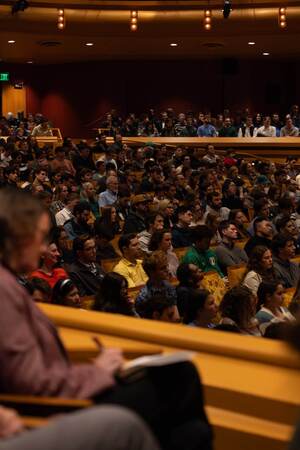
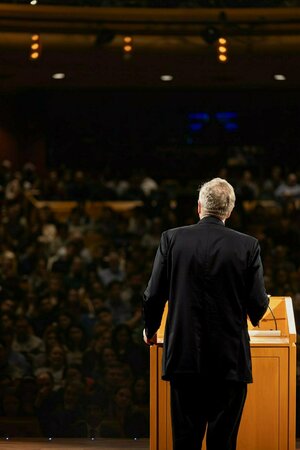
Bishop Barron delivered his talk, "An Old Testament Theology of God," before approximately 650 viewers, including online viewers and the 600+ who gathered in person at the Leighton Concert Hall in the DeBartolo Performing Arts Center here on Notre Dame's campus. The Bishop's talk took as its starting point the observation that the historical-critical method that dominates academic biblical interpretation has, for many interpreters, been separated from the theological interpretation of the Old Testament that one finds in the pages of "the great bishop theologians of the ancient Church," such as Irenaeus, Chrysostom, Gregory of Nyssa, Ambrose, and Augustine. Taking his cue from these great exegetes, Bishop Barron proceeded to survey the rich theology of God in the Old Testament - a theology which the Bishop frequently put into conversation with St. Thomas Aquinas and other important thinkers in the history of philosophy and Christian theology.
Bishop Barron's tour de force survey of the Old Testament doctrine of God focused on the nature of God and God's relationship to his creation, especially humanity. The Bishop began with a section of Scripture known as Second Isaiah (Isaiah chapters 40-55), which shows a doctrine of God's Incomparability. That is, since God is qualitatively "totally other," God cannot be compared to any other being, including other so-called gods worshipped in the Ancient Near East or in the Greek and Roman myths. While these deities were considered to be the most excellent of all things in the world, the Bible speaks of a God who created, and is therefore outside and other than, all temporal and worldly entities. Since God is completely distinct from, and cannot even be compared to, things in this world - the only things of which we have experience - all human language of God must be analogical.
Having established this biblical view of God's nature, Bishop Barron began to consider how it is that a God who is completely "other" relates to the world. Key to the Old Testament's answer to this question is the doctrine of God as Creator. Reading from the same section of Isaiah, Bishop Barron pointed the crowd to Is. 49:15-16, quoting, "Can a woman forget her nursing child? Or show no compassion for the child of her womb?" The point, the Bishop explained, is that just as a human mother cares for her child, so does the divine Creator care for his creatures. God's otherness does not express a God who is absent or who cannot co-exist with other beings, as if they were in competition to occupy a single space. Rather, in the Old Testament God's otherness means that he is both utterly beyond his creatures, and yet intimately near to them, caring for them, and giving to them his infinite goodness. This creative and providential goodness of God, the Bishop goes on to explain, permeates Old Testament texts, from Genesis 1, to the Psalms, to Daniel, and beyond.
For the Bishop, two texts in particular illustrate the relationship of God and creation in the Old Testament. The first is Exodus 3, where God speaks to Moses in a bush that is burning with fire, yet is not consumed. In this image, Bishop Barron finds a beautiful image of the way God's proximity to the world reveals his completely "other" nature. Since God is not in competition with the world, God can be present and active in the world without destroying it. He can, the Bishop says, "set the world on fire without destroying it." Moreover, when God identifies himself to Moses as "the God of your father, the God of Abraham, the God of Isaac, and the God of Jacob" (Ex. 3:6), he shows his loving, personal relationship with his creatures. And when he reveals his name in the statement "I am who I am" (Ex. 3:14), he reveals that he is not merely a type of being, as an ancient person would have thought of the other so-called "gods."
That the Old Testament God is not separate from the world in the sense that he is distant from or removed from the world indicates that God is, as Thomas Aquinas emphasizes, a providential God. In the Old Testament, Bishop Barron finds this doctrine of God's providence most strikingly in the book of Job. Commenting on the latter chapters of the book, Bishop Barron draws on the late Fr. David Burrell, who observes that God's conversation with Job does not take the form of a philosophical argument, but of a conversation between the two. In Job's angry questioning and God's response, we see, in other words, an expression of their relationship with one another. There, we see God, the incomparable, unconditioned, and unknowable Creator of the world, affirming his providential care of all things, including Job. This leads the bishop into his concluding remarks, where he considered what the Old Testament has to say about the ultimate manifestation of God's presence in and care of his creation: the incarnation of his Son.
In the course of the lecture, Bishop Barron fondly recalled his time as a student at the University of Notre Dame, including his conversations with the late Rev. Thomas F. McNally, C.S.C., who played an important role in directing Bishop Barron to the priesthood. He also shared "a father's pride" in seeing many of the novices and postulants that he knew during in his time as a scholar in residence at the University now playing an important part in the University's spiritual and intellectual life, including Fr. Stephen Koeth, Fr. Gregory Haake, and Fr. Peter McCormick. Following the lecture Bishop Barron took questions from several Notre Dame students, including some of our Maritain Student Fellows. Later, he greeted and blessed dozens of guests in a reception hosted by the Maritain Center. We at the Center are incredibly grateful to the Bishop for sharing his knowledge, wisdom, and time with us and with other members of the Notre Dame community.
Did you miss Bishop Barron's Lecture? Not to worry - we recorded it!
Bishop Barron Meets with the Maritain Fellows
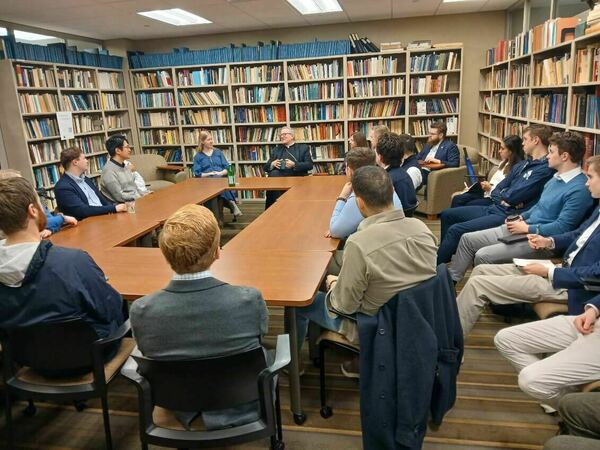
While he was visiting, Bishop Barron met with the Maritain Fellows and other students from campus. In this hour-long discussion, students had the opportunity to ask the Bishop a range of questions pertaining to the life of Church, evangelization, interest in religion and revivalism in "Generation Z," and more. Bishop Barron encouraged students to foster relationships with mentors on campus and to engage seriously in the study of the great voices in philosophy and theology from the history of the Church. The Catholic Church, Bishop Barron explained, is like an ocean liner, not a rowboat. It provides stability and good company for all those who seek to navigate the spiritual, moral, and intellectual waters of the world.
The Maritain Fellows are grateful to Bishop Barron for sharing some of that stable wisdom during their time together. Expressing this gratitude, one student, who is about to complete her J.D. in Notre Dame's Law School, wrote, "The opportunity to meet in a small group with Bishop Barron was one of the highlights of my time with the Maritain Fellows. His call for young people, especially students involved with the Maritian Center, to go out into the world and be lights was a reminder of what education is meant to do. We are prepared to answer God's call in many different ways but always with the touchstone of our education and relationship with Christ. Bishop Barron shared from his heart what it means for students and young people to live well, and did so with joy." The rest of us at the Maritain Center echo these sentiments, and are grateful to Bishop Barron for sharing his time and wisdom with the Notre Dame and Maritain Center community.