Cercle d'études Course

The Maritain Center is proud to sponsor a for-credit discussion-based course, Cercle d'études. This "study circle" is modelled after the paradigm of a long-running discussion group hosted by the great 20th century Catholic thinkers Jacques and Raissa Maritain. Each week, a different visiting professor from Notre Dame gives a short presentation on a topic that students have identified as having particular interest. Then, students are given ample opportunity to dialogue with the professor, their peers, the regular moderator of the Cercle, Professor Jean Porter (Theology), and other members of the community. Read more about the origins of the study-circle, some of our past speakers and discussions, and this semester's incarnation below.
Sign up for Cercle d'études Updates
Cercle d'études: An Overview
Instructor
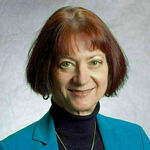
Jean Porter, John A. O'Brien Professor of Theology, is the author of numerous articles and six books on the history of the Christian moral tradition and its contemporary relevance. She has a particular interest in the moral theology of Aquinas and his scholastic predecessors and contemporaries. She has been a member of Notre Dame's theology faculty since 1990 and received the inaugural College of Arts & Letters Graduate Student Mentorship Award in 2023 for dedication to her teaching and mentorship role.
Structure and organization
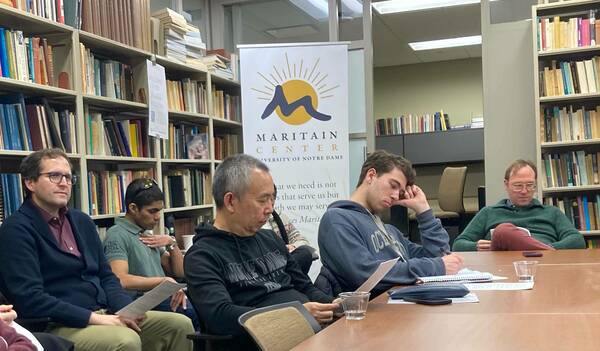
The Notre Dame Cercle d'études is meant to provide an opportunity for sustained discussion, and it is open to any undergraduate student from Notre Dame, St. Mary’s, or Holy Cross. It is offered as a one-credit course, but it is not necessary to enroll in the course in order to participate in the weekly discussions. In either case, there will be no outside preparation, and those who are taking the course for credit will be graded on a Pass/fail basis.
Each week, we will welcome a guest faculty presenter, who will begin our conversation with a few remarks, no more than fifteen minutes in length. We will then open the floor for questions and discussions, in the spirit of a free-wheeling quodlibetal session in which the guest speaker will be invited to expand upon and defend their views. The session will conclude with fellowship, coffee, and snacks. In order to receive credit for this course, you will be required to attend the sessions and participate in the discussion.
You may miss three sessions over the course of the semester, including university excused absences. If you are forced to miss more sessions due to extreme, unforeseen circumstances, come and discuss the situation with the faculty moderator. Beyond that, we confidently expect that all participants will exhibit the standards of courtesy and open-mindedness that are typical of Notre Dame students.
See full details at ND Class Search.
If you plan to participate in the Cercle d'Études without enrolling in the course, please indicate this by emailing jporter@nd.edu and maritain@nd.edu.
The Maritains' Study Circle
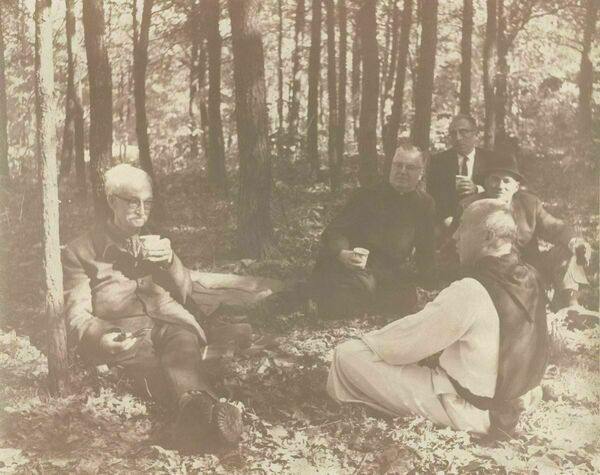
The inspiration and origins of Notre Dame's Cercle d'études is perhaps best-described by former Maritain Center Director, Ralph McInerny. Here is his description of the Maritains' study circle in The Very Rich Hours of Jacques Maritain: A Spiritual Life :
"It was at Meudon that Maritain began the Thomistic Study Circles.....The meetings at the Maritains' seem to have begun without any thought of regular recurrence. Jacques tells us that he found in a notebook this entry: 'First reunion of Thomistic studies at the house, with Picher, Vaton, Barbot, Dadtarac, Massis.' The date of the entry was Sunday, February 8, 1914. There was no immediate sequel to that meeting... World War I broke out in 1914. It was five years later, in the fall of 1919, that regular meetings devoted to Thomistic studies began at the Maritain home in Versailles.....The names of those attending the first meeting were hardly household words, and Maritain describes the participants of the second meeting, which would indeed begin a series, as personal friends and students of his from the Institut Catholique. It was still an informal gathering, and it stayed that way until 1921 when the decision was made to formalize the meetings and to stabilize their point. The participants were those 'for whom the spiritual life and the pursuit of wisdom (philosophical and theological) had major importance....'
From the time of their conversion, the Maritain household had been on a schedule that took its rationale from a dual purpose -- the pursuit of study and the pursuit of sanctity....The discovery of Saint Thomas had opened up the possibility of a more integral connection between the life of the mind and the life of the spirit....When the Maritains became oblates of Saint Benedict under the motto Ora et Labora: Work and Pray, their regimen of prayer and study had taken on a particular stamp, but the Thomistic Study Circles acquired their own character. There was the continuation of the conviction that laymen too were called to sanctity, but the spirit of Versailles was more Dominican than Benedictine, a movement prefigured in a way to Thomas Aquinas's move from the Benedictine Abbey of Montecassino to the Order of Preachers. Most of the participants were lay people -- old and young, male and female, students and professors -- but there were priests and religious as well. The lay people represented a wide range of vocations, not just professional philosophers, but doctors, poets, musicians, businessmen, scientists. Catholics were in the majority, but there were also unbelievers, Jews, Orthodox, and some Protestants. Some were already experts in Thomistic thought, others mere beginners. It was interest in the thought of Thomas Aquinas, albeit in different degrees, that brought them together" ((pgs. 61-63 in the online edition available here).