Maritain Fellows Lecture Series
One of the central pieces of the Maritain Fellows program, the Maritain Fellows Lectures series is designed to foster community, intellectual formation, and spiritual engagement amoungst students. Each lecture allows the Fellows to delve deeper into topics related to philosophy, public life, and the Catholic intellectual tradition. The series is managed by the fellows, with the Graduate and Undergraduate presidents collaborating with their peers to select and invite speakers to campus. The Fellows then have the opportunity to further their reflections over dinner with the speakers.
Upcoming Lectures
While the series is designed for and managed by the Maritain Fellows, all are welcome to attend. While the precise programming may vary, the Fellows hold roughly one lecture per month on average during the semester. For upcoming lectures, visit the Maritain Center's "Events" page.
Spring 2026 Lectures
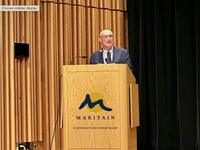
At the end of the 2026 semester, the Maritain Fellows hosted a lecture from Prof. Vittorio Hösle, "What is Philosophy, Rightly Understood? And Why Does it Matter for Society at Large?" After almost 28 years at Notre Dame teaching world literature, philosophy, and political theory, Vittorio Hosle reflected on the nature of philosophy, its links with the other spheres of knowledge, and its social function. He discussed the different ideals of philosophy that are upheld in different cultures, delve into the relation of systematic philosophy and history of philosophy, and explain why he privileges the tradition of objective idealism. He also drew on his experience in the US and European educational systems, offering an insightful comparison of the two approaches to education. For a full write-up on the event and link to a video recording of the lecture, visit our news item.
February 11, 2026: Jason T. Eberl, "When Does Life Begin? Thomist versus Dualist Perspectives"
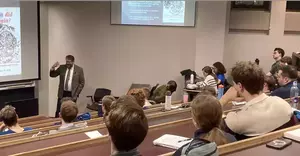
On February 11, 2026, at 6:00 pm, in DeBartolo 126, Prof. Jason T. Eberl gave a lecture addressing the question, "When does a human being become ensouled?" Thomists and dualists have offered differing accounts in response to this question. Prof. Eberl's lecture presented the views of dualists such as Richard Swinburne and William Hasker and instead argued for a Thomistic hylomorphic understanding of ensoulment at conception.
Fall 2025 Lectures
December 1, 2025: Daniel Philpott, "Resurrecting Justice: How Christianity Can Renew Our Political Order"

In December fo 2025, Prof. Daniel Philpott (Political Science, Notre Dame) delivered a lecture, titled, "Resurrecting Justice: How Christianity Can Renew Our Political Order." For centuries, the dominant concept of justice in the West has been the constant will to render another his due. The Bible, though, contains a different way of thinking about justice: comprehensive right relationship. This justice affirms what is due, or rights, but also proffers duties that exceed due such as mercy, hospitality, care, forgiveness and reconciliation. Retrieving this justice, which the classical concept has overswept, holds out promise for politics today in matters ranging from the protection of life, to immigration, to healing the wounds of racial injustice.
October 13, 2025: Fr. Stephen L. Brock, "The Metaphysics of Prayer"

In October 2025, the Fellows hosted Fr. Brock to speak on perplexing questions at the heart of Christian belief and practice: If God is all-wise and all-good, what is the point of asking Him for things in prayer? Prof. Brock considers how this question is answered by two Christian thinkers: C. S. Lewis and Saint Thomas Aquinas. Both regard petitionary prayer as a divinely instituted way of causing things. They differ widely, however, on how such prayer is related to God’s plan for the world. Lewis’s account is fairly easy to understand, and at least at first glance, it seems to be quite plausible. However, it runs into a serious theoretical difficulty, and how Lewis would evidently respond to this difficulty is, at best, counter-intuitive. Saint Thomas’s account is far more challenging than Lewis’s, because of all the metaphysics involved. On the other hand, for Thomas the aforesaid difficulty is no difficulty at all, and his account not only does greater justice to the divine transcendence, but also, surprisingly, assigns to us—to our prayers and our actions—a far stronger role in determining the course of events in the world.
September 22, 2025: Prof. Richard Swinburne, "I am My Soul"
Prof. Richard Swinburne (emeritus Professor of Philosophy at the University of Oxford; author of The Evolution of the Soul , Oxford, rev. ed. 1997; Mind, Brain, and Free Will, Oxford, 2013, and more) delivered a lecture, "I am My Soul," which will engage the thought of Thomas Aquinas and modern theories of personal identity.
Abstract: Most modern theories of personal identity analyse P2 at time T2 being the same person as P1 at time T1 in terms of P2 having a certain amount of the same brain, and/or some of the same memories and character, as P1. But these theories are open to the objection that they are arbitrary. So, contemporary theories now claim that personal identity is a matter of degree. That leads to the possibility that more than one later person is (to some particular degree) the same as some earlier person, which in turn leads to contradictions. Hence, the simple theory: personal identity is all-or-nothing. Yet there must be something which makes a difference between some future person who has a certain particular amount of my brain, and the same memories and character as me, being me and not being me; and since this difference does not consist in any physical thing or physical or mental property, it must consist in a mental thing, a soul. Having my soul is necessary for being me. And the fact that it is conceivable that I could exist without my body, shows that having my soul is sufficient for being me.
Want more? For more Maritain Fellows Lectures, our annual Maritain Lecture series, including Bishop Robert Barron's 2026 address, and other on-campus programming, visit our Maritain Center Videos page, in our online "Collections."