Maritain Fellows Research Grants
Maritain Fellows are able to receive funding from the Maritain Center to advance their research. If you are a Maritain Fellow hoping to present a conference, attend a seminar or workshop, or advance an independent research project, you are welcome to apply for funding assistance.
Apply to receive funding assistance for your research
Maritain Fellows Research Projects
Summer 2026
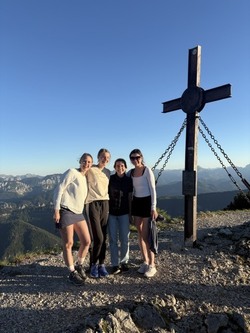
Hildebrand Project's summer course, "Two Pillars of Personalism: Dietrich von Hildebrand and Karol Wojtyła [John Paul II]"
In Summer 2026 the Maritain Center sponsored the research of one of our student fellows, Samantha. Samantha attended the Hildebrand Project's summer course, "Two Pillars of Personalism: Dietrich von Hildebrand and Karol Wojtyła [John Paul II]." The summer class took place in Gaming, Austria in late May/early June. During the course, Samantha read and made a detailed comparison between the two authors, while also meeting fellow students from across the world and collaborating with professors and personal friends of both authors. The course helped not only with Samantha's dissertation research, but also with the preparation of an undergraduate level course on Pope John Paul II. Samantha commented on her experience, "I wish to express my heartfelt thanks to the Maritain Center for their generosity in funding this experience. It was truly the best of my academic career so far, and I am deeply grateful for the opportunity to have been a part of it!"
Read more here.
Spring 2026
2026 Thomas Aquinas Conference (The Aquinas Center for Theological Renewal & The Thomistic Institute): Thomas Aquinas and Sin
In Spring 2026, the Maritain Center supported Nicholas Ramirez's presentation as a conference on Thomas Aquinas, "To Heaven or Hell We Go: Political Implications of a Thomistic Thesis on Nature and Grace after the Fall," at Ave Maria University. Reflecting on the experience, Nicholas said, "This was my first time presenting on political theology and thinking through the political implications of the nature-grace debate in Catholic theology in a public forum. I received great feedback on my paper from scholars and other students, and received encouragement with the direction I was taking my paper. Based on these interactions, the hope is to continue developing these ideas further and continuing working on the paper so that it will be sufficiently prepared for publication within the next year or two."
Nicholas was also struck by the attention to the question of the meaning of habitus in Aquinas and the importance of acquired virtue in Christian life. He notes, "Whether Christians can have the acquired virtues has been a much debated topic in the recent academic literature, and since last semester I have been very interested and have done much research into habitus in the Thomistic tradition. The papers at this conference and the conversations that followed gave me much encouragement in one of my other research interests which I am considering working on for my doctoral dissertation." Nicholas also reported enjoying the opportunity to renew old relationships and foster new ones at the conference. He expressed his thanks to the benefactors of the Maritain Center, writing, "Without your support, I would have been unable to develop my academic research and relationships at this conference."
Summer 2025
Rome Seminar on the Vision of God, Institute for Human Ecology

Sociology graduate student Caitlin Fitzgerald participated in the Institute for Human Ecology's Rome Seminar on the Vision of God. During the seminar, Fitzgerald attended several lectures on the Beatific Vision, accompanied by opportunities for prayer, pilgrimage, and fellowship with other graduate students. Fitzgerald wrote that one of her favorite lectures was given by Professor Daria Spezzano on deification and the beatific vision.
Fitzgerald described the lecture's argument: "the goal of the Christian life is to become like God... through participation in the divine nature. This participation is only possible through grace... an added gift to the gift of nature. We cannot prepare ourselves for grace, as only God can deify us. Grace becomes an infused habitus within us.... In the beatific vision, the blessed participate in God’s clear knowledge of himself with... praise." Further, "in the beatific vision, the blessed dwell in God."
Fitzgerald carried these and similar insights through her journey in Rome, as she visited the Basilica of the True Cross, St. Peter's Basilica and St. John Lateran, climbed the steps of the Scala Sancta, and prayed in the Sistine Chapel. She also attended the officiaI installation of Pope Leo XIV as the bishop of the Basilica of St. Mary Major. Overall, she reported that participating in the seminar was an "academically and spiritually moving experience" and that "it was beautiful to reflect on the divine indwelling and how I can better manifest the reality of the Lord’s presence within me to others."
Saint Mary's Seminary and University Moral Theology and Seminary Teaching Conference
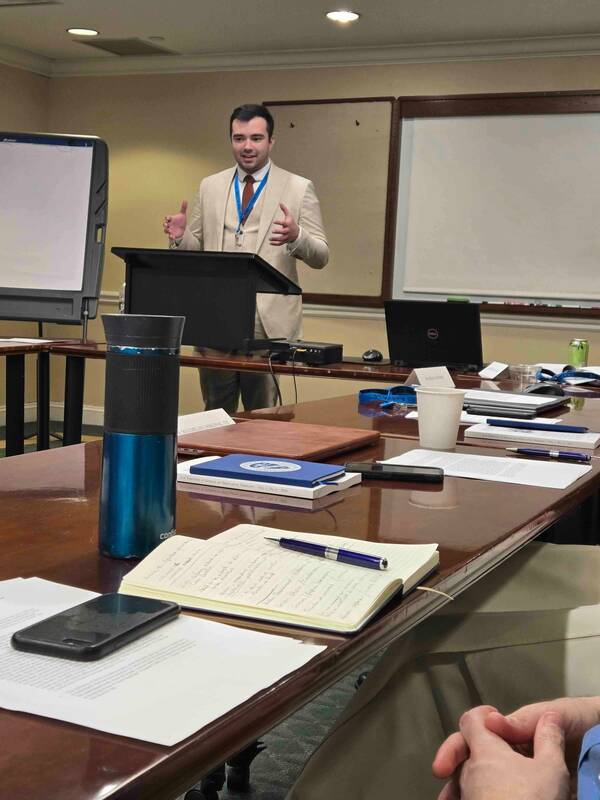
In the summer of 2025 the Maritain Center supported the presentation of Nicholas Ramirez, titled, “The Primacy of Devotion and the Moral Life and Formation of Seminarians.” Ramirez reports that his paper argued, "the act of the will known as devotion, the principal act of the virtue of religion for Saint Thomas Aquinas, is indispensable for better understanding how the seminarian’s entire formative experience can be weaved together and connected, especially the twin pillars of seminarian formation according to Saint Pope John Paul II: prayer and sacred study.... The greater the seminarian’s devotional life, the more he will desire to render homage to God through his study, and the more he studies Divine things, the more he will desire to render his whole life, including his study, into an act of worship."
Ramirez thanked the Maritain Center for funding that allowed him to present at the conference, recieve useful feedback on his paper, and connect with other moral theologians as he begins his doctoral studies in Theology at the University of Notre Dame.